
From Real-Time Shelf Visibility to Predictive Retail: How Grocers Are Digitizing the Store

At FMI Midwinter 2026, a panel titled “From Real-Time Visibility to Predictive Retail: How Grocers Are Digitizing the Store” brought together operators and technology leaders to discuss what store-level digitization actually looks like in practice.
Moderated by former Loblaws and Sobeys CIO Bruce Burrows, the conversation featured:
- Tom Henry, Chief Data & Information Officer, Schnuck Markets
- John DeCicco, Executive Director & CEO, DeCicco & Sons Markets
- Brad Bogolea, CEO & Co-founder, Simbe
The discussion followed a practical maturity curve: Crawl → Walk → Run, outlining how retailers move from basic shelf visibility to predictive intelligence and stronger collaboration with DSD and brand partners.
The emphasis throughout was operational: what changes when shelf data is continuous, trusted, and actionable.
CRAWL: Establish Real-Time Shelf Visibility
The panel began with at same starting point: when both retailers had limited visibility into what was actually happening on their shelves.
For John DeCicco, chain growth exposed the issue.
“When you have a single store, you know every little thing inside the store. But as you grow, it gets harder and harder to really understand the store.”
Out-of-stocks and price mismatches were persistent challenges. The underlying issue wasn’t effort; it was measurement.
“If you can’t measure it, you can’t manage it.”
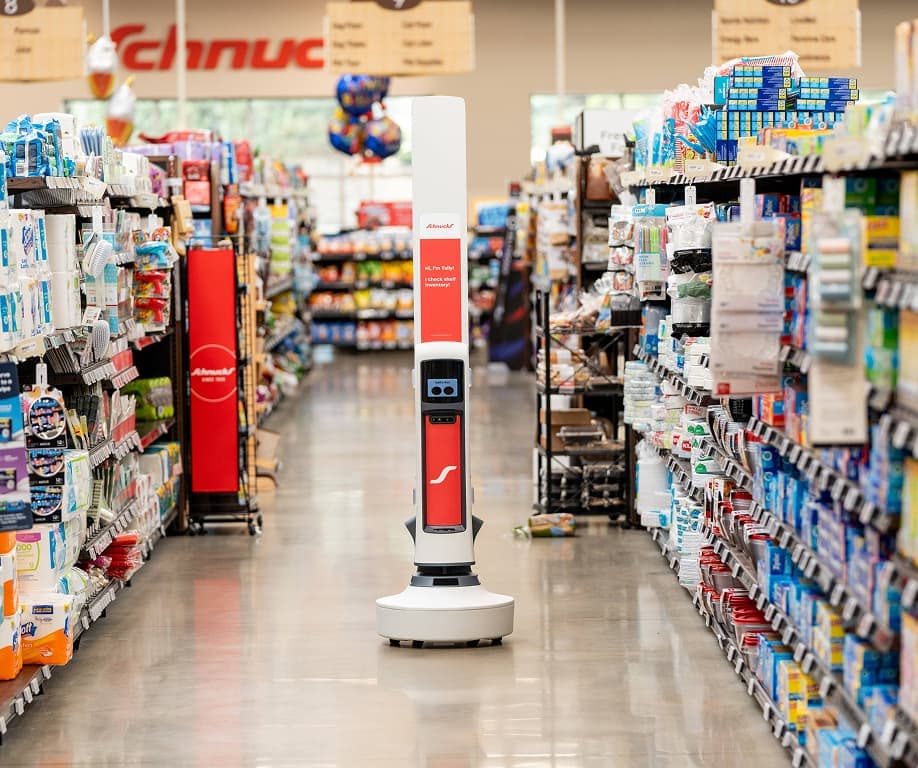
Introducing autonomous, real-time shelf scanning with Tally created that measurement layer. With consistent, full-store scans, both retailers gained a clearer picture of out-of-stock conditions and pricing accuracy.
At Schnucks, the challenge was scaling visibility across more than 100 stores.
Tom Henry emphasized that success depended less on the technology itself and more on how it was introduced:
- Start with pilots
- Validate performance with clear KPIs
- Involve store teams early
- Build cross-functional ownership
He noted that early deployments required converting large volumes of insight into prioritized, manageable tasks.
“Tally became a digital teammate.”
Adoption at the store level made the difference. When teams trusted the output, the data began influencing daily execution.
WALK: Turn Visibility into Operational Performance
Once shelf visibility was consistent, both retailers began connecting that data to other workflows.
Merchandising & Space Optimization
At DeCicco & Sons, product location data captured by Tally was combined with 52-week sales, cost, and profit information to evaluate performance across categories and stores.
That analysis supported more structured planogram development and improved execution.
John shared a practical example of how his team’s use of Tally’s data evolved:
“We measured how many inches of space we had with no tag on the shelf.”
Beyond out-of-stocks, the team began identifying unproductive space and missed merchandising opportunities.
Operational Use Cases at Scale
At Schnucks, a weekly cross-functional group reviews shelf data and identifies new applications. Over time, this led to:
- Feeding location data into digital pick paths
- Improving eCommerce find rates by suppressing out-of-stock items
- Integrating shelf gaps into ordering workflows
- Validating third-party counts against store-level data
Tom summarized the progression simply:
“It just keeps on giving.”
The shift wasn’t a single transformation. It was incremental improvements layered into existing processes.
RUN: Layer Predictive Intelligence and Collaboration
The final stage focused on how accurate shelf data supports more advanced analytics and retailer–brand collaboration.
AI-powered Stores Built on Reliable Data
Schnucks is applying forecasting models and AI tools across workforce planning and category analysis. Henry pointed to what he described as “agentic merchandising:” using combined internal and external data to analyze performance and recommend adjustments.
He also emphasized a prerequisite:
“All of these advanced technologies are worthless if your data is not accurate.”
The panel returned repeatedly to this theme: predictive retail requires trusted inputs.
Independent Advantage Through Precision
For DeCicco & Sons, scale is less important than speed and clarity.
By combining inbound vendor ASN data with nightly shelf scans, managers receive daily “hit lists” identifying what arrived but has not yet reached the shelf.
“Being able to give managers a hit list every day… that’s very helpful.”
The result is improved accountability and consistently high availability standards.
Shared Data Across the Ecosystem
The discussion closed with retailer–brand alignment.
Henry noted:
“As an industry, brands and retailers have to do better with common data.”
DeCicco shared an example of using shelf imagery to demonstrate to a vendor why performance was down, shifting the conversation from opinion to evidence.
Simbe CEO Brad Bogolea added that real-time shelf visibility strengthens syndicated data and supports better execution programs—but only when grounded in accuracy.
A Practical Maturity Curve
The maturity path discussed at FMI Midwinter was straightforward:
Crawl — Establish consistent, store-wide shelf visibility.
Walk — Connect that visibility to merchandising, labor, supply chain, and digital workflows.
Run — Apply predictive tools and strengthen ecosystem collaboration on top of accurate data.
The conversation made one point clear: digitizing the store is less about adding new systems and more about making the shelf measurable and using that measurement to improve execution.
From there, more advanced capabilities follow.
See It in Practice
The maturity curve outlined by Schnucks and DeCicco & Sons begins with one step: making the shelf measurable.
See how retailers are applying real-time shelf intelligence across store operations, merchandising, and digital commerce.
![[On Demand] Real Talk | What Using Robots in Retail Stores is Really Like](/_next/image?url=https%3A%2F%2Fcdn.sanity.io%2Fimages%2Foh42c9n6%2Fproduction%2F8cb019fe8c1a0e3317a85dfff2d95fad7fc5038a-3240x1700.png&w=3840&q=75)