
Retail Robots in Public Spaces: Why UL 3300 Certification Matters

Lynn Brook
What is retail robot safety?
Retail robot safety is the set of engineering practices, operational standards, and independent certifications that ensure autonomous robots can operate in busy, public store environments safely. Unlike industrial robots that work in controlled spaces alongside trained operators, retail robots share open space with people. That difference changes what "safe" means.
Retail robot safety encompasses five core areas: safe navigation around people, functional reliability of control systems, mechanical and docking safety in public spaces, stability across real-world retail flooring and layouts, and electrical and charging safety. It also extends to the operational policies that govern how and where robots are deployed.
Retail robot safety is what allows automation to deliver measurable operational outcomes including inventory accuracy, labor efficiency, and execution consistency.
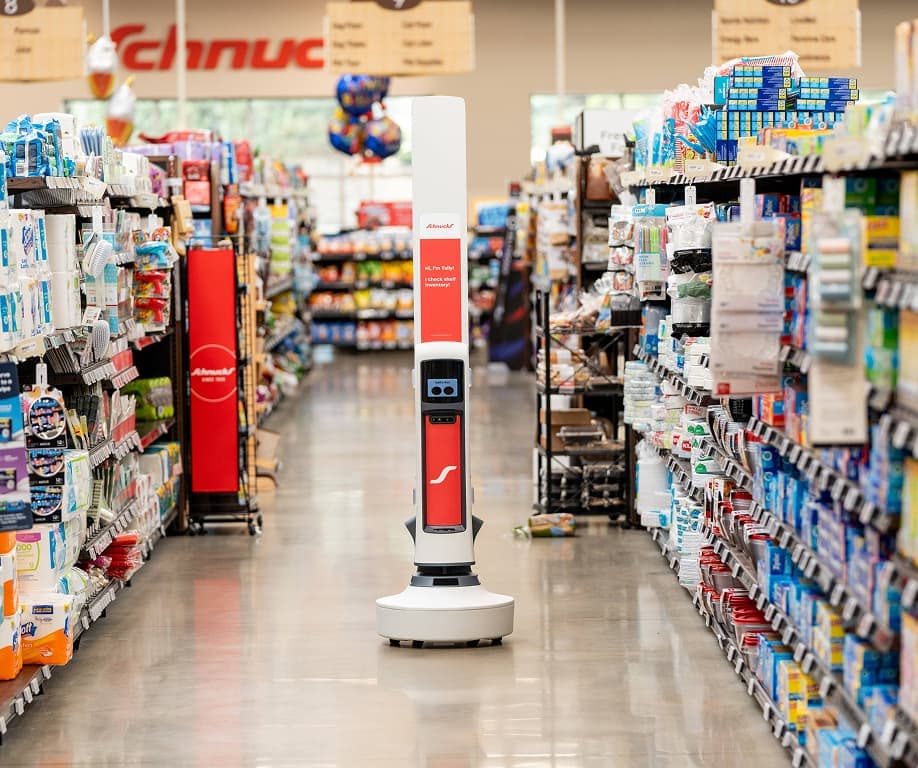
Simbe is the first retail robotics company to achieve UL 3300 certification for Tally, setting the standard for product-level safety in retail robotics. UL (Underwriters Laboratories) is a global safety science organization that develops and validates standards for real-world products. Simbe also maintains SOC 2 Type II assurance and ISO/IEC 27001 certification, reinforcing enterprise-grade security.
Retail stores are dynamic environments that change by the hour. A pallet appears where there wasn’t one before. A child darts across an aisle and spills milk. An associate steps backward while helping a customer. This constant motion makes safety fundamental for robots operating in the same space.
For years, the conversation around retail robotics has centered on capability. Can robots navigate? Can they scan shelves with precision? Move pallets, clean floors, and assist with picking?
Another centrally important question is how safely and consistently robots do those things alongside people. That is where certification standards matter and why Tally’s recent, industry-first UL 3300 certification is so important.
Why retail robots require a different safety standard
In controlled industrial settings, environments are structured around machines. Lanes are defined, access is controlled, and workflows are designed to reduce variability. Safety protocols are built around trained personnel operating within those systems.
Retail is fundamentally different. Robots operate in open, public environments where the people around them are not trained operators. When robots and humans share physical space, robots must adapt to people. That distinction changes what “safe” means.
A store robot must:
- Navigate unpredictable human movement and everyday obstacles like carts and boxes
- Respond in real time when conditions shift
- Dock and charge in customer-facing spaces
- Perform consistently across flooring types, layouts, traffic patterns, and product resets
In this context, safety is not only about preventing unwanted outcomes. It is about earning daily trust through consistent, predictable behavior.
UL 3300 certification was created for robots operating in dynamic, public-facing environments, evaluating mechanical and electrical systems, control logic, and software behaviors as they work together in the real-world.
Why retail robot safety matters for store operations
Safety is not a procurement checkbox, it is an operational prerequisite for scaling automation in retail stores. It protects:
- Brand experience and shopper trust: A robot that behaves predictably becomes part of the store environment. 96% of shoppers have a positive or neutral response to seeing Tally in store.
- Operational continuity: A certified, reliable robot keeps inventory available for shoppers and store execution on track.
- Risk and compliance posture: Independent safety certification gives EHS, legal, and procurement teams a recognized framework for evaluation, reducing the friction of internal review and accelerating deployment timelines.
Store team confidence and adoption: Store teams are more likely to embrace robots that they trust. 90% of store managers say Tally makes their job easier.
What product-level certification signals
It is relatively easy to certify components in isolation. A battery can meet a standard. A subsystem can pass a test. A sensor can be evaluated in a lab.
But retailers deploy complete systems that must operate safely, consistently, and predictably across fleets, stores, and regions.
UL 3300 evaluates the robot and its charging dock as an integrated product intended for public operation, validated through extensive third-party testing. It gives operations, IT, risk, and compliance teams a shared framework for evaluating robots as part of everyday store operations.
“Since 2015, we've designed Tally to earn trust from shoppers navigating aisles, store teams working alongside it, and the retailers deploying it at scale.”
- Jeff Gee, Chief Design Officer, Simbe
The five safety foundations behind store-ready autonomy
The following five foundations capture the safety areas that matter most in retail environments and map directly to system-level behaviors UL 3300 evaluates.
1) Safe Navigation Around People
A store robot must detect and respond to shoppers and store teams in real time. That includes collision risk mitigation and protective stopping behaviors that are intuitive to anyone nearby and do not require training to operate safely in a retail aisle.
2) Functional Safety of Control Systems
Safety-critical behaviors need to perform consistently, even when conditions change. Functional safety methods focus on predictable outcomes, including validation across different safety classes and established methodologies.
3) Public-Space Mechanical and Docking Safety
Customer-facing environments introduce realities controlled settings do not. Movement, docking, and physical clearances must support safe interaction amid diverse traffic patterns, including safeguards across movement and charging.
4) Stability and Real-World Handling
Retail floors are not uniform, and validating performance across common retail flooring and fixtures helps ensure safe and consistent operation day after day.
5) Electrical and Charging Safety
Power systems must operate safely and dependably under the environmental conditions of active stores. UL 3300 includes electrical and power considerations and resilience testing aligned with real-world operational stressors.
Together, these foundations reflect a shift in how retail robotics are evaluated. UL Solutions emphasizes that UL 3300 addresses the unique safety requirements of robots operating in public environments with near constant human interaction and that independent validation provides retailers, store teams, and shoppers with confidence in safe operation in dynamic stores.
How OSHA enters the conversation
Public-space safety is only part of the picture. Retail stores are also workplaces. Associates operate equipment, and employers are responsible for maintaining safe working environments.
In the United States, OSHA (Occupational Safety and Health Administration) oversees workplace safety. Through its Nationally Recognized Testing Laboratory (NRTL) Program, OSHA recognizes standards that apply to equipment operating in workplace environments.
UL 3300’s inclusion on OSHA’s NRTL Program list is significant because it places the standard within a recognized workplace safety framework. In practical terms, UL 3300 is acknowledged as an appropriate safety standard for robots operating in commercial and enterprise environments.
“When a standard is recognized within the OSHA framework, it gives employers clarity. It connects innovation to established workplace safety expectations and makes internal evaluations more straightforward.”
- Michael Sakamoto, Senior Global Business Development Manager, UL Solutions
For retailers, that clarity gives safety, EHS, compliance, and risk teams a familiar reference point and reduces friction in procurement and deployment reviews. The conversation shifts from vendor claims to alignment with a workplace-recognized safety standard.
Safety and security move together
Physical safety is only one dimension of enterprise readiness. Modern store technology must also meet disciplined information security expectations, particularly when systems handle operational data and customer-related information.
SOC 2 Type II evaluates whether systems and operational controls supporting the Store Intelligence platform are not only well designed, but operating effectively over time across areas such as security, availability, confidentiality, and oversight.
ISO/IEC 27001 certification goes further by validating a formal, risk-based information security management system. It confirms that policies, controls, risk management practices, and continuous improvement processes are in place to protect information assets at an organizational level.
Together, these validations reinforce that enterprise readiness is not limited to how a robot behaves in the aisle. It extends to how the entire platform is governed, secured, and maintained.
At scale, physical trust and digital trust are inseparable. Retailers need confidence that robots operate safely in-store and that the systems behind them are managed securely and responsibly.
What this signals for the category
Standards like UL 3300 do more than validate a single product. They establish expectations for what responsible autonomy looks like in public, human environments.
When independent, system-level safety validation becomes part of the baseline conversation, retailers gain confidence. Teams spend less time debating whether automation is safe and more time focusing on how to scale it.
That shift unlocks autonomy that is safe, predictable, and ready for the real-world complexity of retail.
Frequently Asked Questions: Retail Robot Safety
What standards apply to robots operating in retail stores?
UL 3300 is the primary safety standard for autonomous robots operating in public and commercial spaces in the US, covering navigation, mechanical design, control systems, docking behavior, and electrical safety. It is recognized under OSHA's Nationally Recognized Testing Laboratory (NRTL) Program, placing it within established workplace safety frameworks. ISO/IEC 13482 and related ISO service robotics frameworks are also referenced by manufacturers and safety engineers for risk assessment and design validation.
How is retail robot safety different from industrial robot safety?
Industrial robots typically operate in access-controlled environments alongside trained personnel. Retail robots share open floor space with the public — including children, elderly shoppers, and individuals with mobility limitations. This means safety systems must be intuitive and effective without requiring any training or adjustment from the people around them.
What does UL 3300 certification actually evaluate?
UL 3300 evaluates the complete robot system, not just individual components, including navigation and collision avoidance logic, mechanical stability, docking and charging safety, control system reliability, and electrical performance under real-world operational conditions. Tally is the first retail robot to achieve this certification.

Lynn Brook
Sr. Director, Product Marketing
Lynn Brook is Senior Director of Product Marketing at Simbe, where she leads positioning, go-to-market strategy, and customer advocacy. She brings over 15 years of product marketing experience at retail technology companies, specializing in multi-audience commerce environments with leadership roles spanning high-growth startups to billion-dollar companies.

![[On Demand] Real Talk | What Using Robots in Retail Stores is Really Like](/_next/image?url=https%3A%2F%2Fcdn.sanity.io%2Fimages%2Foh42c9n6%2Fproduction%2F8cb019fe8c1a0e3317a85dfff2d95fad7fc5038a-3240x1700.png&w=3840&q=75)