
Shelf Coverage in Large-Format Retail: Balancing Efficiency and Experience

Anil Taneja

Large-format retail, whether mass merchant, wholesale club, farm supply, or home improvement, operates in a completely different environment than smaller brick & mortar locations. The stores are often more than 100,000 square feet, with corresponding challenges in maintaining accurate, reliable shelf execution and store conditions.
Compared to grocery or drug stores, shopper visits tend to be less frequent but far more intentional. Customers arrive with a mission: to complete a project, stock up for their business, or make a planned purchase they’ve researched ahead of time. Because of the mission-driven nature of these trips, substitution that’s acceptable elsewhere (“I’ll grab a different brand of mascara or milk”) rarely works.
The wrong drill bit, an unavailable plumbing fitting, or a missing add-on like sanding pads can derail an entire project or just as importantly, lead to cart abandonment. In home improvement, where competition is largely zero-sum, a broken purchase journey often means the sale doesn’t disappear, it simply moves to a competitor.
While many shoppers arrive having already researched what they want to buy, associates still play a critical role in helping customers validate their decisions, locate complementary items, and ensure everything needed to complete the project is actually in hand. That guidance often determines whether the purchase is completed in-store, online, or abandoned altogether.
However, associates in large-format retail are often pulled between competing priorities: validating shelf conditions across a massive footprint and helping shoppers who need real expertise. Whether they’re tracking down missing products, confirming on-hand accuracy, or performing manual stock checks, every minute spent diagnosing inventory issues is a minute not spent helping someone complete a purchase.
Shelf Execution Stakes in Large-Format Retail Are High
In home improvement, a missing $4 electrical connector can stall a $400 project. A customer may have set aside their entire Saturday to fix something, only to discover a crucial part isn’t available on the shelf.
In wholesale clubs, a business customer buying a specific soda syrup or beverage concentrate can’t complete the trip if it’s unavailable. Without it, they can’t serve that product to customers, and the visit often ends without a purchase.
In farm supply, a producer coming in for livestock feed can’t complete the trip if it’s not available. Feeding schedules don’t pause, and missing that product immediately disrupts routine animal care.
Operationally, the costs add up. Inventory moves more slowly and ties up more capital. A phantom snow blower count in September may not be caught until the winter rush. A pallet of flooring hidden in the steel can distort ordering for weeks. A seasonal reset with mislabeled SKUs can ripple through systems for an entire quarter.
More square footage creates more opportunities for friction, both for customers and for the bottom line.
Large-Format Stores Need a Different Technology Playbook
Given these pressures—customer expectations, huge physical footprints, and operational complexity—retailers face a fundamental question: How do we maintain accurate, prioritized shelves without burning out teams or wasting effort?
It’s not about scanning more aisles or adding more manual checks. The real challenge impacting the shopper experience is a lack of scalable, strategic visibility.
Physical processes like wall-to-wall audits or constant aisle walks don’t scale in stores of this size. They’re time-intensive, inconsistent, and quickly become outdated. What retailers need instead is a smarter way to deploy labor and technology, one that provides actionable insight at scale and directs effort where it will have meaningful impact.
What an Optimal Coverage Strategy Looks Like
A coverage strategy starts with recognizing that not all shelves carry equal weight.
Some aisles hold the products customers came specifically to buy: revenue drivers and trip-critical items. Others contain accessories or consumables that complete a project and increase basket size. Some areas are highly seasonal or tied to promotional cycles. And throughout the store, secondary locations hold high-margin items that often get overlooked.
A modern, effective strategy does five things:
1. Focus on high-value areas: Prioritize departments and items where on-shelf availability most directly affects sales or customer satisfaction.
2. Adapt to seasonal and demand shifts: Adjust for outdoor and garden in spring, holiday décor in winter, or back-to-school resets in late summer.
3. Cover secondary and project-completion locations: Include accessories, consumables, and add-ons that complete the shopping mission for the customer.
4. Stay dynamic: Adjust and align coverage as shopper behavior, product mix, or layout changes throughout the year.
5. Create reliable visibility: Use real-time data—item location, on-hand accuracy, pricing, and movement trends—updated many times per day, not just during audits.
When retailers can see what’s actually happening on the shelf with this level of clarity, labor can be deployed more intelligently. Teams fix issues that matter most and spend more time serving customers instead of searching.
How Technology Helps
Large-format retailers are increasingly replacing unscalable, manual processes with automated computer-vision-driven solutions that deliver consistent, prioritized shelf visibility. In stores of this size, technology can help see the right things, in the right places, at the right time.
The most effective approaches share a few defining characteristics.
- Full-stack capabilities built for retail. Shelf digitization works best when hardware and software are designed together, with solutions purpose-built for in-store execution. Advanced computer vision and AI automate manual processes and surface the most important issues so store associates, store leaders, and operations teams can focus on what matters most.
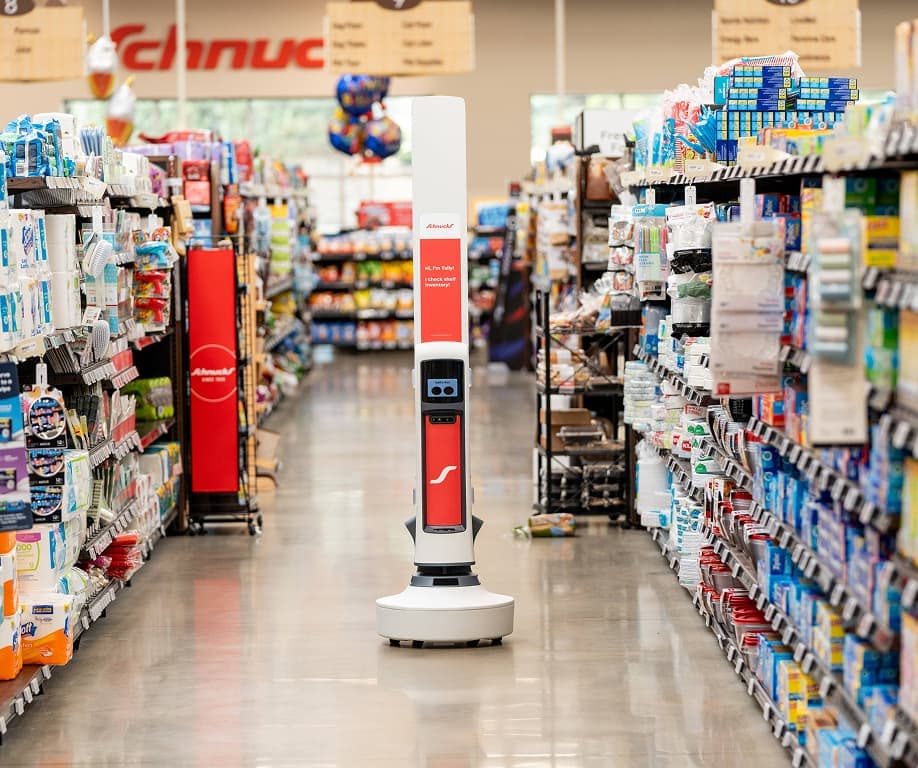
- Multiple sensor modalities to match store realities. While autonomous mobile robots deliver the most comprehensive and accurate shelf visibility, no single sensing approach can address the full complexity of large-format retail. Leading approaches combine autonomous mobile robots, fixed sensors for high-traffic or high-risk areas, and RFID for categories like soft goods and electronics. This multimodal model allows retailers to design coverage strategies that reflect how their stores actually operate, prioritizing trip-critical categories, high-velocity zones, and seasonal departments rather than relying on wall-to-wall audits or constant aisle walks.
- Mobile execution for store teams. Visibility only creates value when it drives immediate action. When computer vision identifies issues like phantom inventory, misplaced product, low-on-shelf conditions, or pricing discrepancies, those insights must reach store teams in a clear, usable way. Mobile tools—across iPhone, Android, and Zebra devices—deliver prioritized tasks and guided workflows, helping associates spend less time validating shelf conditions and more time helping customers complete purchases.
- Virtual and multi-store oversight for leaders. Large-format retail requires consistency across locations, but constant travel isn’t scalable. Virtual store views and multi-store dashboards give headquarters and field leaders a real-world picture of execution across the chain, making it easier to spot patterns, address systemic issues, and refine coverage strategies over time without stepping foot in every store.
In large-format environments, where scale magnifies both inefficiencies and opportunities, this level of precision creates measurable impact. An integrated, multimodal approach reduces data gaps, scales efficiently across hundreds of stores, and lowers total cost of ownership while supporting the ultimate goal: better shelf execution and a better customer experience.
When Customers Win, Retailers Win
The goal of large-format coverage is not to blanket every aisle. It’s to be strategic balancing business priorities, store realities, and customer needs.
When shelves are accurate and associates have more time to serve, several things happen:
- Customers complete their missions with confidence
- Teams spend time where it counts
- Retailers turn complexity into efficiency, loyalty, and growth
At its core, shelf intelligence is not about counting products. It’s about creating the right environment for customers to find what they need. And when customers succeed, large-format retailers do too.
Learn more about Simbe for Home Improvement, Wholesale Club, and Farm Supply

Anil Taneja
Senior Director, Retail Strategy & Scaling
Anil Taneja is Senior Director of Retail Strategy & Scaling at Simbe. He brings nearly two decades of strategy, consulting, and customer growth experience across retail and CPG, including a Global Partner Alliance Leader role at AWS, VP of Customer Growth and Customer Success at InContext Solutions and SwiftIQ, and management consulting at PwC and The Cambridge Group.
![[On Demand] Real Talk | What Using Robots in Retail Stores is Really Like](/_next/image?url=https%3A%2F%2Fcdn.sanity.io%2Fimages%2Foh42c9n6%2Fproduction%2F8cb019fe8c1a0e3317a85dfff2d95fad7fc5038a-3240x1700.png&w=3840&q=75)