
The Foundational Fix Grocery Retailers Need Before Chasing 'Shiny Objects'

Dave Steck
Plato said it best about two millennia ago, “The beginning is the most important part of the work.” In grocery retail, for the customer, the beginning is the shelf edge. Quite simply, they want the product they need to be on the shelf and available to purchase. If retailers don’t get that right, nothing else matters.
In this world of rapidly expanding compute power and exponential AI growth, businesses are rushing to stay out in front, often without taking the time to look back at the beginning. We look to new shiny objects to get ahead. We forget that brute force won’t overcome the crumbled foundational elements—the very basics of retail execution. Without a solid surface beneath our feet, it’s easy to quickly get disillusioned about a given technology and move on to the next new shiny object.
If the core of your basic infrastructure is built on older technologies and/or disconnected systems and broken processes, we effectively have the crumbling foundation of a very old home. Any remodeler will tell us that it’s impossible to build anything on top of a structurally unsound foundation.
In grocery retail, there is a technology explosion, all with promises of delighting the customer and increasing revenue. At NRF this year, you couldn’t walk 10 feet without seeing shiny objects everywhere. To say AI was everywhere would be an understatement.
But how many of those amazing technologies will work if the underlying core customer need—the location and execution of physical product—is wrong?
The vast majority of the things at NRF work only if all of the foundational elements are in place. You can have all the AI in the world, but if you don’t have the product on the shelf, you won’t see revenue gain.
Getting down to basics
To listen to Plato, let’s go back to the beginning - the shelf edge. Having the product on the shelf is where it all begins for the shopper journey. Moving from manual ordering or Computer Assisted Ordering and onto Perpetual Inventory (PI) systems can provide some help but that still falls short. PI drifts for a multitude of reasons - warehouse mispicks, incorrect scanning, case packs change, theft and the list goes on, which ultimately results in an empty shelf.
We rely on our over tasked store teams to fill the gap. We hand them a device and ask them to scan outs. But don’t scan items we have in the backroom, don’t scan what’s on display or in a shipper—and make sure that you provide excellent customer service while you’re doing all of that. And the big kicker, corporate is going to measure you on out percentages and if you go over a certain amount, you’re going to have to do some explaining. Ultimately, the team fails and the customer suffers, or worse, shops elsewhere.
The right shiny object
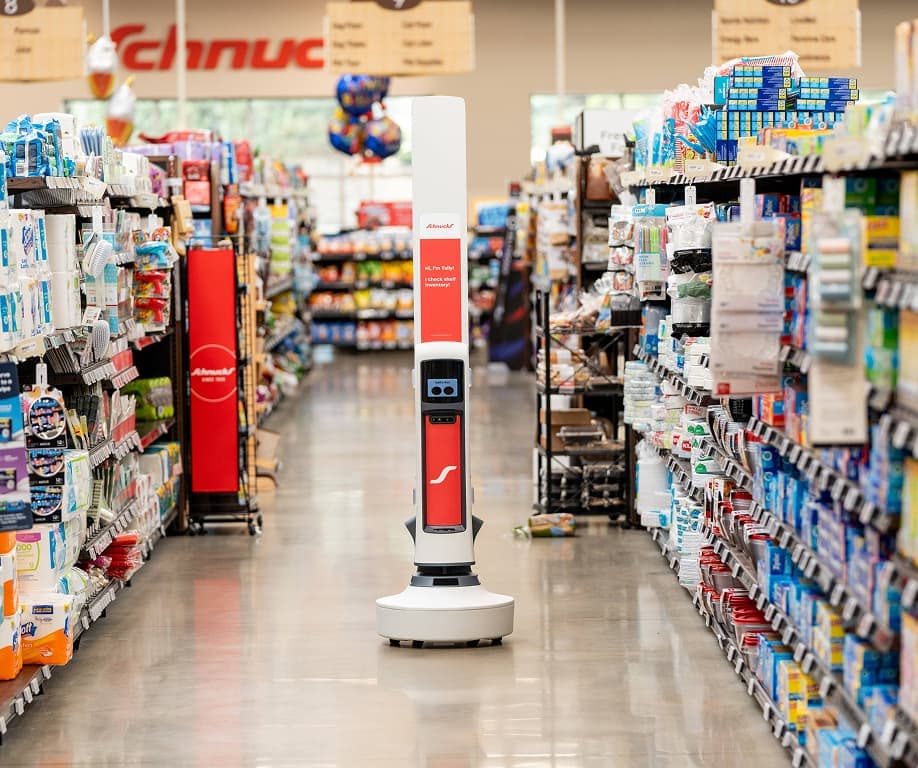
This is where foundational technology, deployed correctly, changes the narrative. I go back to 2020 when I put the Tally robot from Simbe in a new store, and I talked to the store manager who was dead-set against having a robot. He argued that he had the best team in the chain (which was true) and the robot was not going to do anything to help. After six weeks of using Tally, I called him to share that we would be reducing items from the store task list. He argued with me to not cull the list, he wanted to have the entire list. I reminded him that 6-weeks prior he didn’t even want the robot.
A direct quote from him, “Dave, in my 42 years with the company, this is the best tool that has ever been given to the stores”.
By introducing a robot, you create a consistent routine of scanning shelves. You improve your on-shelf position, you greatly improve customer satisfaction, your ecommerce is more reliable, you know what products are actually in the store and where they are, you know how your store teams are performing and you increase revenue because you’re not trying to sell air.
Start at the beginning - fix the shelf edge. Once you understand the data from a robotics deployment, you will have built the strong, reliable foundation required to fully leverage the promise of all those other new technologies—and truly stay out in front.

Dave Steck
President, Steck Consulting, LLC | Simbe Expert in Residence
Dave Steck is President of Steck Consulting and serves as Simbe's Expert in Residence. He spent 11 years as VP of IT & Innovation at Schnuck Markets, where he led the grocer's rollout of Tally, making Schnucks the first grocery chain to deploy in-store robotics at scale. He now writes and speaks frequently on shelf digitization, store execution, and the operational realities of scaling in-store automation, including at Groceryshop, FMI, and GroceryTech.
![[On Demand] Real Talk | What Using Robots in Retail Stores is Really Like](/_next/image?url=https%3A%2F%2Fcdn.sanity.io%2Fimages%2Foh42c9n6%2Fproduction%2F8cb019fe8c1a0e3317a85dfff2d95fad7fc5038a-3240x1700.png&w=3840&q=75)