
What Retailers Can Learn from Tractor Supply’s AI Panel: Insights from Simbe SVP Benjamin Bond

Lynn Brook
At Tractor Supply Company’s 2026 Partnership Conference in Nashville, Simbe SVP of Strategy and Client Success Benjamin Bond joined leaders from Google, AHEAD, and Clootrack for a discussion on a question increasingly important to retailers: Who owns the customer when AI is in the middle?
Moderated by journalist Steve Kovach, the conversation spanned customer data, agentic commerce, shopper trust, autonomous systems, and the growing connection between digital shopping and the physical store.
The discussion kept coming back to one thing: retailers need an accurate view of what shoppers will find on the shelf.
Below are highlights from the discussion, edited for length and clarity.

Q: Who owns the customer when AI is in the middle?
A (Benjamin Bond): If you want to get a group of executives fired up, ask them who owns the customer. I think the more important question is: who owns the customer outcome?
For retailers, first things first, that means availability. We’ve spent the last decade evolving the promise we make to shoppers around convenience, reliability, availability, and value.
When I go to the store, the product the website told me was there needs to actually be there. Those are the fundamental problems behind conversations about digital growth and comp-store sales growth, and they’re the problems we’re actively working on.
Q: Retailers have more data than ever. What retail data is still missing?
A: There’s a lot of maturity across the retail data landscape. The one missing piece has always been what’s on the shelf right now. Not what we planned to be there. Not what we hope is there. What shoppers will actually find.
Where we identify a gap between reality and expectation, there’s an opportunity. That’s where we can help guide the store to act.
“Where we identify a gap between reality and expectation, there’s an opportunity.”
Q: What does agentic commerce need to earn shopper trust?
A: I think the primary trust gap for agentic commerce looks a lot like the trust gap in digital commerce today.
I want this product. Am I going to get it?
It’s not just, “I think it’s there.” It’s, “I know it’s there. I saw it 30 minutes ago.”
That’s a big part of what we’re working on with Tractor Supply and other retail partners. In the most extreme version, you can show the shopper the shelf at the store down the street so they have that confidence.
As AI agents take on more of the shopping journey, connecting the digital answer to what a shopper will find in the store becomes even more important.
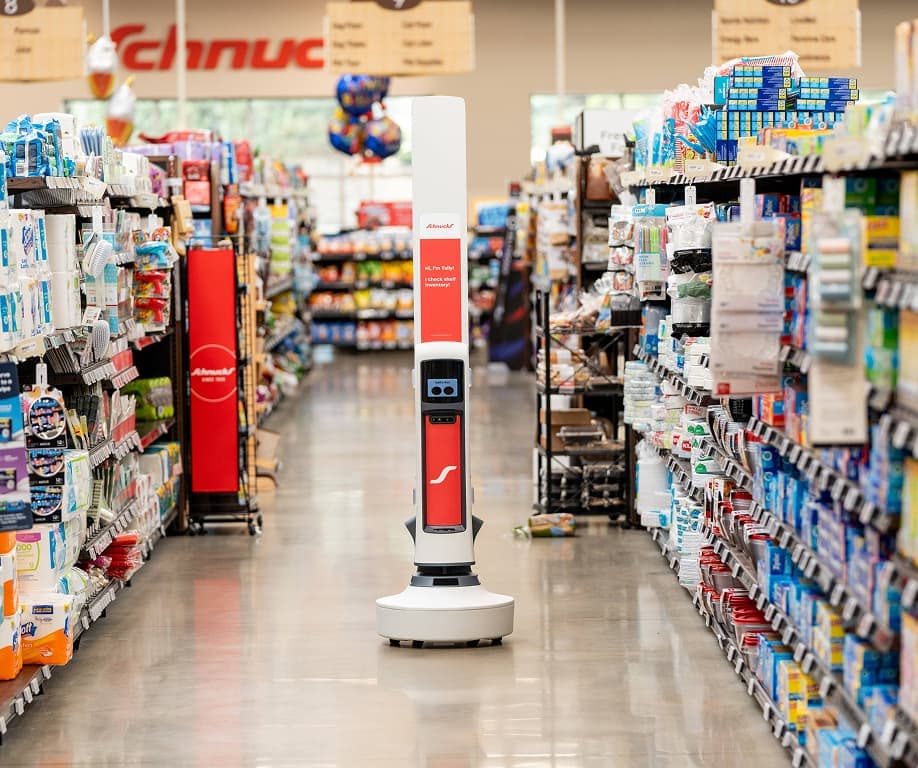
Q: How autonomous is Tally in a live retail store?
A: Today, 99.9% of our operations are completely autonomous. We wouldn’t be successful if they weren’t.
When you see Tally navigating a store, it can look pretty straightforward. Then you zoom out. We have to do that autonomously across thousands of stores around the world, around senior citizens, kids, store teams, carts, and crowded aisles at peak times. These are busy environments with stores to run and business outcomes to deliver.
The robot has to make numerous decisions concurrently. What’s in its path? How should it respond? Did it miss part of the store? Was that the most important promotional display, and does it need to get back there quickly?
We think about Tally as an autonomous physical agent. It’s executing a mission against an ever-present set of priorities while adapting to what’s happening around it.
Q: Where is Tally’s physical AI headed next?
A: A lot of our focus is on more dynamic missions.
Imagine someone, from a store leader to a senior corporate executive, saying, “Tomorrow morning, I need you to look at this across 2,000 stores,” and getting a precise answer.
Or a store leader saying, “It’s evening. I need to know if the assigned execution got done.”
We’re solving those questions at every level of the business. That ability to dynamically ask the physical store a question, at one location or across an entire fleet, is where it gets really interesting.
Q: How can better store visibility improve ecommerce fulfillment?
A: The worst-case scenario is that you have the shopper intent, you get the conversion, and then you miss part of the basket.
That hurts the sale. But the bigger challenge is when the shopper decides, “I can’t count on this retailer,” and doesn’t come back.
Inventory accuracy and visibility are incredibly consequential. The obvious problem is when a product shows as available online, but the inventory data is wrong and the shelf tells a different story. That’s a solvable problem.
But the inverse is also true.
Many retailers are so fearful of disappointing the shopper that they become increasingly conservative about what they show as available online. That means a significant share of the assortment may never get shown, even though the product may be sitting on the shelf.
That’s a missed opportunity for the retailer and the shopper. With better visibility, we can say, “You should have higher confidence here. We just saw it.”
Then there’s the person fulfilling the order. Today, that’s still usually a person who may not know the store well. Finding one specific product in the moment can be incredibly inefficient.
By giving people picking products precise aisle and product-level navigation, we can cut pick times by 40 to 50%. Discover how BJ’s reduced pick times by 40%.
Q: What changes for retailers as shopping becomes more AI-driven?
A: The digital experience is becoming more capable of understanding what someone wants and helping them find the right product. But eventually, that interaction reaches the store.
The question becomes: Is the product there? Is it where it should be? Is the information accurate? And can the store act when something isn’t right?
As shopping becomes more AI-driven, confidence in what’s happening on the shelf becomes even more critical.


Lynn Brook
Sr. Director, Product Marketing
Lynn Brook is Senior Director of Product Marketing at Simbe, where she leads positioning, go-to-market strategy, and customer advocacy. She brings over 15 years of product marketing experience at retail technology companies, specializing in multi-audience commerce environments with leadership roles spanning high-growth startups to billion-dollar companies.
![[On Demand] Real Talk | What Using Robots in Retail Stores is Really Like](/_next/image?url=https%3A%2F%2Fcdn.sanity.io%2Fimages%2Foh42c9n6%2Fproduction%2F8cb019fe8c1a0e3317a85dfff2d95fad7fc5038a-3240x1700.png&w=3840&q=75)