Why Simbe Is The Leader In Physical AI and Store Intelligence for Retail

Lynn Brook
Retail is one of the most critical systems in our economy. It’s how people access food, clothing, household essentials, and the products that make everyday life function. Yet for decades, retailers have operated without a live understanding of what is happening inside their stores: what is on the shelf, priced correctly, in the right place, and what needs action now.
Historically, the answer has been manual audits. Store teams walk aisles looking for issues, headquarters rely on lagging reports, and merchants, operators, supply chain, DSD suppliers, CPG brands, and digital teams all work from data that is often incomplete or outdated. But manual audits are not just among store teams’ least favorite tasks. They are also difficult to execute consistently, highly limited in coverage, and unable to keep pace with modern retail.
Every channel of commerce, in-store, e-commerce, same-day delivery, and retail media, depends on the same reality: what’s on the shelf. Digital demand cannot be met if the physical layer underneath it is not accurate. That is the gap physical AI is built to close. Where most AI works from records and reports, physical AI goes into the physical environment observing conditions as they exist rather than relying on what systems believe to be true.
Retail is moving toward perpetual instrumentation of the store. As the industry evolves from managing people and processes to managing people, agents, and robots, real-time, systems-level execution becomes essential. Leading retailers are already building this foundation today, with real-time visibility into shelf conditions and data that flows across store operations, supply chain, merchandising, e-commerce, and digital channels.
That level of visibility changes the operating model. Store teams no longer need to walk aisles searching for problems. They can be directed to the highest-value action in the moment. Online grocery and delivery teams no longer need to hope inventory data is accurate. They can know where items are and reduce substitutions and pick times. Merchants and brands no longer need to rely on reports that are weeks or months old. They can operate from a living system of record for the shelf.
As retail becomes more agentic, this foundation becomes even more important. AI systems can only act with the precision of the data they are built on. Digitized shelves are the physical AI foundation that makes smarter, faster, more automated retail possible.
At Simbe, we have built the Store Intelligence™ platform to be that foundation: the physical AI platform for global commerce. Only Simbe combines autonomous data capture, real-time intelligence, open integration, and trusted deployment at global scale to make the physical store both legible and operable in real time.
Only Simbe Has Proven Market Leadership at Global Scale
Simbe is trusted by more retailers worldwide than any competitor, with deployments across more than 3,000 stores, nearly a dozen countries, and nearly a dozen retail sectors. Our retail partners include leading grocery, wholesale club, home improvement, and farm supply retailers, along with Fortune 100 and Global 2000 enterprise companies.
That breadth matters because no two retailers operate the same way. Store layouts, product assortments, merchandising strategies, fulfillment models, and shopper expectations vary. A solution that works in one environment does not automatically scale across chains, geographies, and formats. Simbe has proven it does, not in innovation labs or limited pilots, but chainwide across some of the most operationally complex retailers in the world.
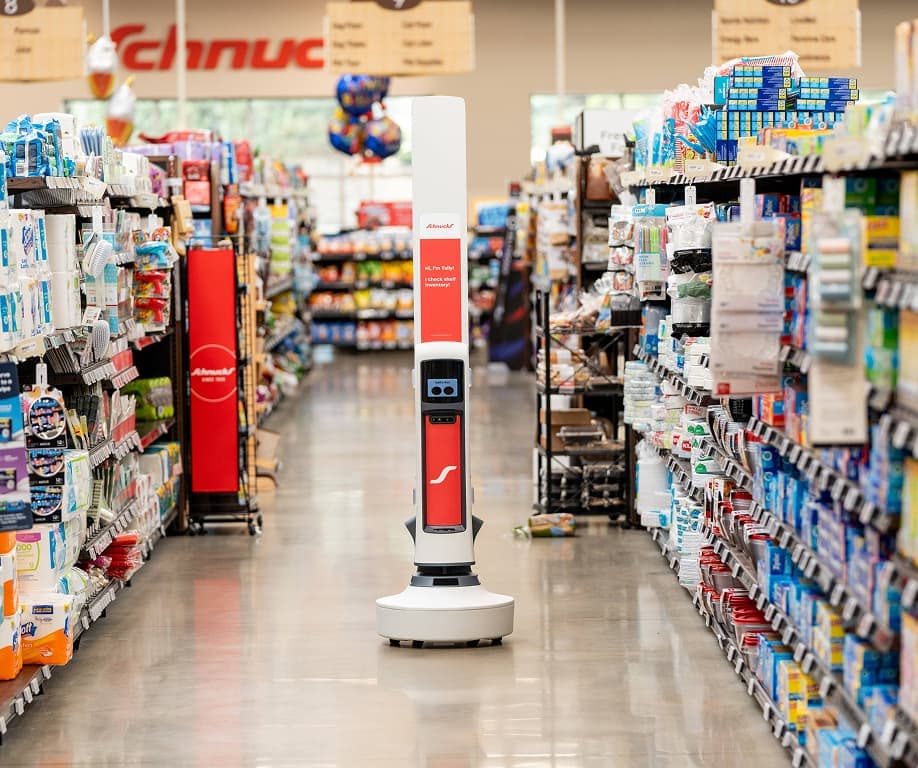
Tally has traveled more than 2.5 million kilometers across those stores, the equivalent of circling the globe 62 times, scanning more than 20 billion price tags and detecting more than 731 million out-of-stock instances along the way.
Simbe’s category leadership is also reflected in how shoppers and store teams respond to the technology. Shoppers prefer Tally to other in-store robots, and 90% of store managers say Tally makes their job easier and that they prefer to work with it.
"Tally gives us superpowers. Simbe's amazing insights are the fundamental and compelling platform on which we'll build."
- Krystyna Kostka, SVP, Store Operations, BJ’s Wholesale Club
Only Simbe Provides Complete Multimodal Store Coverage
Some approaches rely on a single data capture method, such as fixed cameras, handheld scans, manual photos, or periodic store walks. These can provide pieces of the picture, but they cannot deliver the frequency, consistency, and full-store coverage required to run modern retail operations.
Only Simbe combines autonomous mobile capture through Tally and Tally RFID and with fixed sensors through Tally Spot for always-on, full-store visibility across every aisle, every day. And offers the ability to have 360 degree coverage to virtually walk the store any time of day or night.
Tally autonomously scans the store to capture inventory, pricing, and product-location data. Tally RFID extends autonomous intelligence to RFID-tagged categories such as apparel and electronics. Tally Spot adds targeted, high-frequency monitoring in high-turnover and high-risk areas where retailers need even more frequent visibility.
Fixed camera-only approaches that install devices across every aisle in the store have struggled to succeed at scale. The model adds installation and maintenance overhead, and even a dense grid of cameras still has blind spots a fixed angle cannot see around. Simbe uses fixed sensors selectively, in the specific high-turnover, high-sales areas that call for extra-frequent monitoring, and pairs them with autonomous mobile robot capture everywhere else. The result is full-store coverage without the operational weight of wall-to-wall cameras.
Together, these modalities create a complete and flexible platform. Retailers do not have to choose between broad coverage and targeted monitoring. Simbe adapts to the operating environment, capturing the right data through the right modality and turning it into intelligence teams can act on.
“Fixed cameras have their place in time, but it's not something I would look at for an entire store. You're looking at having to manage hundreds of cameras on the shelf versus one robot.”
- Dave Steck, former VP of IT Store and Emerging Technology, Schnuck Markets
Only Simbe Delivers Best-in-Class Computer Vision Accuracy
Simbe Vision™ delivers unmatched frequency, fidelity, and 99% shelf-label accuracy, providing a complete, high-precision view of every shelf with no added labor required. Trained on 60B+ shelf images and 18M+ unique SKUs, Simbe Vision is built for the real-world complexity of retail environments.
Frequency ensures retailers are not relying on stale snapshots. Fidelity ensures the image quality is strong enough to distinguish subtle shelf conditions, similar-looking products, labels, and price tags. Accuracy ensures teams can trust the recommendations and take action with confidence.
Just as important, Simbe does not require store teams or third-party labor to manually capture new product images every time the shelf changes. Simbe’s technology works in the background, continuously capturing shelf conditions and adapting as stores evolve.
“Tally has helped my team reduce our OOS rate by 50% in one of our highest volume stores by providing prioritized pick lists for every category. With the challenges of everyday operations and the shortage of personnel in the labor force, this is the first time we have been able to cover every aisle every day.”
- Nick DeSetto, Manager of Shrink Analytics and Inventory Control, Shoprite Supermarkets, Inc.
Only Simbe Is Actionable From Day One
Retailers have seen too many technologies that require extensive setup before they deliver value. Some depend on perfect planograms. Others require a specific shelf-edge infrastructure. Others take weeks or months of configuration, mapping, or model training before insights become useful.
With Simbe, there is no planogram or ESL dependency and minimal setup ensures insights that adapt automatically as stores evolve. Tally can be operational in less than one day, requires only 3 square feet of space, and uses one robot and one plug.
But day-one actionability is not only about setup. It is about how the data reaches the people who need it.
Simbe turns shelf data into clear, prioritized actions through Simbe Mobile, helping store teams resolve inventory, pricing, replenishment, and execution issues more efficiently. Insights are also delivered through dashboards, digital and print reports, APIs, and remote visibility tools, giving store leaders, merchants, operations teams, and executives the right view for their role.
“Other projects we were looking at required more hardware or a lot of different departments to integrate. While Tally touched a few, it was easy. It was a technology that we were able to get in and see results quickly. “
- VP Finance, Leading Food Distribution and Retail Company
Only Simbe Is Vertically Integrated and Enterprise-Ready
Simbe’s proprietary CV/AI, RFID, sensors, and high-fidelity data accelerate AI transformation and keep the total cost of ownership low, while flexible APIs integrate with core retail systems.
Because Simbe owns and integrates the key layers of the platform, from capture to intelligence to application, retailers avoid the complexity and risk that can come from disconnected hardware, software, and data dependencies. The platform is purpose-built for retail shelf intelligence, not stitched together from components optimized for other use cases.
That matters as more retail technology becomes software-only. Analytics and AI platforms that do not own a capture layer (the hardware that physically collects shelf data) still need image or inventory data to come from somewhere, a retailer’s own cameras, a third-party feed, or manual updates, before they can generate a single insight. When that underlying data is incomplete or inconsistent, everything built on top of it inherits the same gaps. Simbe owns capture, intelligence, and action inside one system, so the accuracy of every recommendation is tied directly to the accuracy of the source, and Simbe controls both.
At the same time, Simbe is designed to fit into the retail technology ecosystem. Flexible APIs allow Simbe insights to integrate with systems across inventory, pricing, e-commerce, analytics, supply chain, and merchandising.
This is where the platform becomes a foundation for broader transformation. High-fidelity shelf data does not only help retailers fix today’s out-of-stocks or pricing errors. It creates the real-time data layer that future AI systems, agents, and automation strategies require. With a precise understanding of store conditions, AI can prioritize, route, and eventually resolve issues across thousands of stores continuously.
“We are at an inflection point where robotics and AI can truly change how retail operations work.”
- Chandhu Nair, SVP of Stores, Data, AI & Innovation, Lowe’s
Only Simbe Is Certified for Safe Autonomous Operation in Public Retail Spaces
For autonomous technology to scale in stores, it must earn trust from shoppers, associates, operations leaders, IT teams, and risk stakeholders.
Simbe is the first retail robotics company to achieve UL 3300 certification for Tally. This independent certification confirms that Tally meets rigorous safety requirements for service robots operating in dynamic, public-facing environments.
As part of the certification process, Tally passed more than 40 safety tests across areas including safe navigation around people, functional safety of control systems, public-space mechanical and charging safety, store stability, electrical systems, battery safety, charging, and EMC resilience.
Public spaces filled with shoppers, associates, carts, displays, changing traffic patterns, and constant human interaction. UL 3300 certification gives retailers independent validation that Tally is built for safe, reliable operation in the real world. In the EU, Tally also holds CE certification, meeting the health, safety, and environmental protection standards required to operate across the region.
Independent certification is not the same as a safety claim made in a press release. A company can describe a robot as safe, or ready to operate around people. Only accredited third-party testing proves it, and today, Simbe is the only retail robotics company that has done that work.
Simbe’s enterprise readiness extends beyond physical safety. The company also operates under an established SOC 2 Type II framework and maintains ISO/IEC 27001 certification, reinforcing its commitment to platform integrity, information security, and operational trust.
"Simbe's achievement as the first retail robotics company to earn UL 3300 certification demonstrates their leadership in advancing responsible deployment. This independent validation provides retailers, store teams, and shoppers with confidence that Tally meets the highest standards for safe operation in dynamic store environments.”
- Sherry He, Vice President and General Manager of Consumer, Medical and Information Technologies, UL Solutions
Only Simbe Combines Technology Leadership With True Partnership
Retailers consistently call Simbe their most visionary and strategically collaborative partner, backed by white-glove onboarding from a team of in-house retail and consulting experts who ensure smooth deployment and long-term success.
Store intelligence touches many parts of the organization: store operations, merchandising, IT, e-commerce, supply chain, finance, and executive leadership. Simbe works with retailers to align stakeholders, define KPIs, support change management, train teams, and identify new sources of value over time.
As retailers mature with Simbe, the use cases expand. Shelf data can improve replenishment, pricing accuracy, fulfillment, vendor collaboration, merchandising execution, store oversight, retail media, and AI-enabled decision-making. What begins as visibility becomes a new operating foundation.
"When you find a partner like Simbe that is as committed to your success as you are, that is a real partnership. They become an extension of your team."
- Tom Henry, Chief Data & Information Officer, Schnuck Markets
Built for What Retail Needs Next
The next era of retail will be defined by stores that are instrumented, intelligent, connected, and increasingly automated. But that future cannot be built on partial visibility, stale data, manual audits, or disconnected point solutions.
The next era of commerce requires physical AI infrastructure. Every channel, in-store, digital, and everything in between, depends on retailers knowing what is truly happening on the shelf. Retailers need a platform that captures the truth of the store, turns it into action, integrates with the systems they already use, and scales safely across real-world environments.
Only Simbe brings together proven market leadership, complete multimodal coverage, best-in-class computer vision, day-one actionability, vertically integrated enterprise technology, independently certified safety, and true partnership with retailers and store teams.
The outcome is the physical AI platform for global commerce: a more accurate, more agile, and more intelligent operating model for retail.
Ready to see Simbe in your stores? Request a demo or calculate your ROI.
Frequently Asked Questions: Simbe, Store Intelligence, and Physical AI for Retail
What is physical AI in retail?
Physical AI is intelligence that operates in the physical world rather than working from records and reports. Where most AI works from data like sales records, transaction logs, and inventory systems, physical AI goes into the physical environment itself, observing conditions as they exist rather than relying on what systems believe to be true. Simbe's Store Intelligence platform is the physical AI foundation for retail, giving teams a live, accurate view of what's happening on the shelf and the intelligence to act on it.
How does Simbe use fixed cameras compared to fixed camera-only solutions?
Simbe combines both. Tally autonomously scans every aisle for full-store coverage, while Tally Spot fixed sensors are deployed selectively in high-turn or high-priority areas that benefit from more frequent monitoring. Fixed camera-only approaches install devices across every aisle, adding wall-to-wall overhead, planogram dependencies, and blind spots a fixed angle cannot see around. Simbe uses fixed sensors where they add the most value and pairs them with autonomous mobile capture from a robot everywhere else.
What makes Simbe different from software-only AI platforms?
Software-only AI platforms don't own a data capture layer. They depend on a retailer's cameras, third-party data feeds, or manual updates before they can generate a single insight. When that underlying data is incomplete or inconsistent, every recommendation built on top of it inherits the same gaps. Simbe owns the full stack from data capture through intelligence, so the accuracy of every recommendation is tied directly to the accuracy of the source.
Is Simbe the only retail robotics company with UL 3300 certification?
Yes. Simbe is the first and only retail robotics company to achieve UL 3300 certification for Tally. Issued by UL Solutions, this independent certification confirms Tally meets rigorous safety requirements for autonomous robots operating in dynamic, public-facing retail environments, validated through more than 40 independent safety tests.
How quickly can Tally be deployed in a store?
Tally can be operational in less than one day. It requires only 3 square feet of floor space, one plug, and no planogram or ESL dependency. No months-long configuration or infrastructure buildout is required before teams start seeing insights.
How does Tally compare to manual shelf audits?
Tally detects 10x more out-of-stock instances than manual audits and scans every aisle every day for frequent and consistent data capture. Store teams receive prioritized task lists in real time rather than walking aisles searching for problems. Manual audits cover a fraction of the store on any given day and produce data that is often outdated before it reaches decision-makers.

Lynn Brook
Sr. Director, Product Marketing
Lynn Brook is Senior Director of Product Marketing at Simbe, where she leads positioning, go-to-market strategy, and customer advocacy. She brings over 15 years of product marketing experience at retail technology companies, specializing in multi-audience commerce environments with leadership roles spanning high-growth startups to billion-dollar companies.
![[On Demand] Real Talk | What Using Robots in Retail Stores is Really Like](/_next/image?url=https%3A%2F%2Fcdn.sanity.io%2Fimages%2Foh42c9n6%2Fproduction%2F8cb019fe8c1a0e3317a85dfff2d95fad7fc5038a-3240x1700.png&w=3840&q=75)