
Robotics at Scale, GLP-1, and Agentic AI: Inside the Conversations Shaping Retail in 2026

Lexie (Sirak) Myers
Recently, leaders from Schnuck Markets, Giant Eagle, The Dialogic Group, Loblaw and Sobeys, and Simbe joined Omni Talk at the Simbe booth to discuss what is changing inside stores. The setting was grocery. The implications span grocery, mass, club, home improvement, soft lines, and other store-led formats.
Halfway through 2026, the trends those leaders surfaced are the same ones reshaping retail strategy now: robotics moving from pilot to scale, GLP-1 rewriting category planning, agentic commerce shifting from concept to consumer behavior, and mid-market retailers outpacing larger chains on speed. Below are the conversations, distilled.
Is 2026 the year retail robotics reaches scale?
Yes. Robotics reaches scale when shelf intelligence is embraced as foundational for store technology, enabling a new retail operating model.
Thom Blischok, CEO of The Dialogic Group, set the tone: "2026 is the year of robots at scale. Robotics are helping retailers change shelf productivity, change people's productivity, and change the shopping experience."
According to Coresight Research's State of In-Store Retailing 2026, 97% of retailers have deployed or plan to deploy store intelligence within the next year, and 60% have already scaled or are actively scaling — up 18 percentage points year over year. Yet in-store inefficiencies now cost U.S. retailers 6.4% of gross sales annually, totaling $196.4 billion across key retail sectors.
Operational inefficiencies continue to rise because many deployments occur before the underlying shelf data infrastructure is in place. As Deborah Weinswig, CEO and Founder of Coresight Research, put it: "Prioritization determines return. Retailers that deploy shelf digitization technology first build a compounding advantage that is difficult to replicate." The proof:
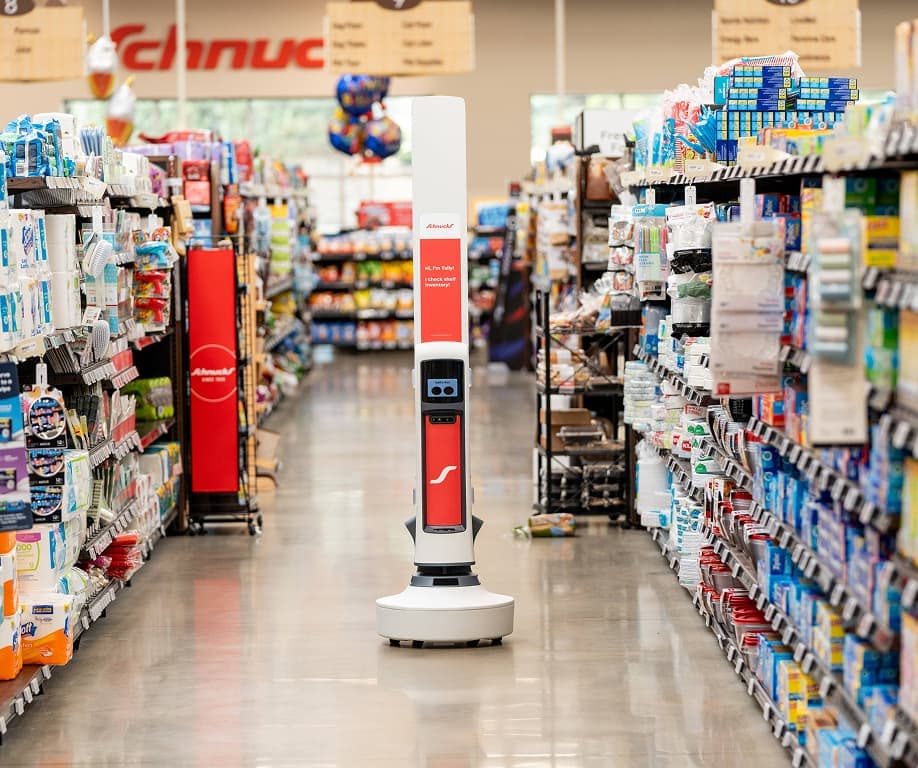
Bruce Burrows, former CIO of Loblaw and Sobeys, names the proof point clearly: "Schnucks has been using the Tally robot longer than any other person has. They're right at the run stage." What "running" actually looks like: at the crawl stage, retailers feed item and price data already flowing to stores into Tally to find shelf gaps and pricing mismatches — no new APIs needed. At the walk stage, they add planogram compliance, space optimization, and digital twin visibility so merchandising, operations, and field teams work from the same evidence. At the run stage, they connect shelf data to replenishment, DSD accountability, e-commerce pick paths, and CPG collaboration. The shelf becomes an operational signal, not a store report.
That's how Schnucks runs. "Hope is not a strategy," says Tim Horton, VP of Center Store at Schnucks. "But knowing really helps us get better."
Watch: Thom Blischok · Bruce Burrows
How are GLP-1 drugs changing retail merchandising and store execution?
GLP-1 adoption is reshaping space, availability, and category flow across protein, fiber, fresh, and nutrient-dense foods in grocery stores today.
Tim Horton, VP of Center Store at Schnuck Markets, framed the shift directly: "The consumer is changing based on trends in the macro space. Health and wellness has a different definition for many consumers now — because of GLP-1 popularity and because of the change in their entire dynamic of eating in the home."
The pressure shows up first in space allocation. Horton pointed to performance nutrition as the clearest example: "It is a race to figure out how we get as much space as quickly as we can."
Justin Weinstein, Chief Marketing & Merchandising Officer at Giant Eagle, said the conversation has intensified: "The next big trend we're seeing is fiber. And that doubles back into the GLP-1 trend."
This is not just a center store story. GLP-1 is changing demand signals across fresh, pharmacy, digital, and promotion. With patients advised to eat nutrient-dense food and protein as they eat less, fresh produce—and berries in particular—has emerged as a category breakout. For retailers, the operational challenge is keeping high-velocity, perishable categories reliably in stock and on shelf. Closing that gap is exactly what fixed-sensor shelf intelligence, like Tally Spot, is designed for. Shelf intelligence applied to fresh closes the gap between what's on the planogram and what's actually available to the customer—expanding the operational reach of high-quality nutrition across every store, not just the flagship.

Watch: Tim Horton · Justin Weinstein
How is agentic commerce reshaping grocery in 2026?
Shoppers are already using AI to plan decisions. Commerce workflows are catching up, and the retailers buying the right partner stack — not building their own — will move first.
Justin Weinstein did not hedge on where this is going: "There should be real hype around it. Any trend changing the way people interact with tech and make decisions is something we should pay attention to."
Customers are already using AI to think through meals, diets, shopping decisions, and daily choices. The gap is between the AI experience and the commerce experience — especially in grocery, where basket size, substitutions, meal planning, price, and availability all collide.
Where retailers go wrong is trying to build the AI stack themselves. Bruce Burrows, former CIO of Loblaw and Sobeys, was direct: "We're not in the technology business. We're in the retail business. Every time I've seen a homegrown solution, it tends to get built and then left to decay over time." His follow-on caution: "We've got to avoid getting agent sprawl the way we have solution sprawl. Find these super agents." The retailers winning with AI are buying the platform, then building differentiation through their own customer context, store workflows, and data strategy.
Watch: Justin Weinstein · Bruce Burrows
How can mid-market retailers compete with enterprise scale?
Mid-market retailers can beat larger chains on speed when they pair focused technology bets with local execution.
Bruce Burrows has worked with both, and the gap surprised him: "I'm super impressed with how the mid-market is adopting technology. Some of the bigger companies are much slower, much more bureaucratic. Schnucks has been using the Tally robot longer than anyone." Thom Blischok's playbook for independent operators sharpens the same point: get the technology mix right, get the store experience right, and get collaboration right.
The pattern holds beyond grocery. In any store-led format — home improvement, club, farm supply — fewer decision layers, closer field feedback, and a stronger need to differentiate can turn a scale disadvantage into a speed advantage.
The deeper edge is people. Mid-market operators win on the relationships their store teams build with customers, and shelf intelligence amplifies that by giving teams their time back. Coresight Research's *State of In-Store Retailing 2026* found that retailers using store intelligence reallocate 86% of the time previously spent on manual tasks toward merchandising, product expertise, and the customer experience — what Caitlin Allen, SVP of Market at Simbe, calls "enabling teams to focus on higher-value work for the customer."
Watch: Bruce Burrows · Thom Blischok
The trends shaping retail in 2026 and beyond
Robotics is scaling. GLP-1s are reshaping the shelf. Agentic commerce is moving from concept to consumer behavior. Mid-market operators are outpacing larger chains on speed. These aren't 2027 predictions — they're the operating reality halfway through 2026, and the retailers acting on them now will define the next chapter of physical retail.
For the full data picture behind these conversations, read Coresight Research's State of In-Store Retailing 2026 — Simbe's third annual study with Coresight Research and RELEX Solutions on what separates retailers realizing return from those scaling into noise.

Lexie (Sirak) Myers
Growth Marketing Manager
Lexie (Sirak) Myers leads Growth Marketing at Simbe, focused on demand generation, SEO/AEO, and content performance. She brings prior marketing and analytics experience from roles at Nitrogen, OpenComp, and JPMorgan Chase & Co.
![[On Demand] Real Talk | What Using Robots in Retail Stores is Really Like](/_next/image?url=https%3A%2F%2Fcdn.sanity.io%2Fimages%2Foh42c9n6%2Fproduction%2F8cb019fe8c1a0e3317a85dfff2d95fad7fc5038a-3240x1700.png&w=3840&q=75)